The Kurdish Language and Literature
Professor of Kurdish language and civilization
at the National Institute of Oriental Language and Civilization of the University of Paris (INALCO).
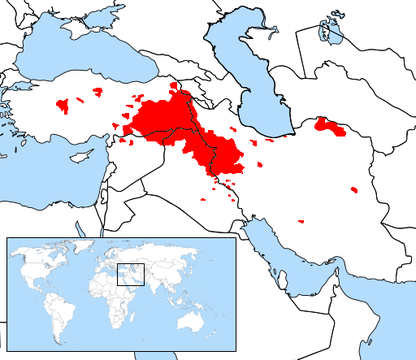
Kurdish is the language of more than twenty million Kurds living in a vast unbroken territory.
Kurdish belongs to the family of Indo-European languages and to the Irano-Aryan group of this family.
The Iranophone tribes and peoples of Central Asia and of the bordering territories begin moving towards the Iranian plateau and the littoral steppes of the Black sea at the turning point of the second and first millennium B.C.
As these tribes and peoples invade the area, they asimilate and give their language and their name to other Irano-aryan peoples already present on the land. Some refuse total assimilation. Even today there are fairly large pockets of non-Kurdophone Kurds living in Kurdistan of Turkey, of Iran of and of Iraq.
Kurdish, the language of the Kurds, which belongs to the north-westem group of Irano-Aryan languages has never had the opportunity to become unified and its dialects are generally separated into three groups with distinct similarities between them.
The biggest group, as regards the number of people who speak it, is the northern Kurdish, commonly called "Kurmanjî", spoken by the Kurds living in Turkey, Syria, the USSR and by some of the Kurd's living in Iran and Iraq. This language is also spoken by 200,000 Kurdophones settled around Kabul, in Afghanistan.
This group gave birth to a literary language.
The central group includes the Kurdish spoken in the north-east of Iraq, where it's called "Soranî" and the dialects of the neighbouring areas, beyond the Zagros, in Kurdistan of Iran. This group also gave birth to a literary language.
There has always been an intellectual elite amongst the Kurds who, for centuries, expressed themselves in the conqueror's language. Numerous Kurdish intellectuals wrote just as easily in Arabic and in Persian as in Turkish. This is shown in the XIIIth century by the Kurdish historian and biographer, Ibn al-Assir, who wrote in Arabic, whilst Idris Bitlisi, a high Ottoman dignitary, of Kurdish Origin, wrote the Hesht Behesht (The Eight Paradises) in 1501, which recounts the first story of the eight first Ottoman sultans, in Persian. The Prince Sharaf Khan, sovereign of the Kurdish principality of Bitlis, also wrote his "History of the Kurdish nation", at the end of the XVIth century, a brilliant medieval source on the history of the Kurds, in Persian.
It's difficult to date the origin of Kurdish literature. Nothing is known about the pre-Islamic culture of the Kurds. Moreover, only some of the texts have been published and it's not known how many diappeared in the torment of endless conflicts which have been occuring on Kurdish territory for several centuries.
The first well-known Kurdish poet is Ell Herirl, who was born in 1425 in the Hakkari region and who died around 1495. His favorite subjects are already those which his compatriots will treat most often: love of the fatherland, its natural beauties and the charm of its girls.
Kurdistan, in the XVIth century is a battlefield between the Persians and the Turks. The Ottoman and Persian Empires are permanently formed and, at the beginning of the second half of the century, stabilize their borders, in other words they share the territory of the Kurds, Kurdistan.
The first famous literary Kurdish monuments date from this epoch. They are born man and Persan at the same and in opposition to the consolidation of Otto neighbors.
The most famous poet from the end of the XVIth and beginning of the XVIlth century is the sheik Ehmede Nishani, known as Melaye Jeziri.
He was born in Jezire Bohtan, and like many well read people of the time, he knew Arabic, Persian, and Turkish well. He was also influenced by Arabo-Persian literary culture. His poetic work of more than 2,000 verses, has remained popular and is still republished regularly.
He travelled a lot and made numerous disciples, who tried to imitate their master by adopting his language, which from then on became the literary language.
Gradually the feeling of belonging to the same entity develops amongst the Kurds. This epoch will see the birth of the poet Ehmedi Khani, native of the Bayazid, who defines in his Mern-o-Zin, a long poem of more than 2,650 distiches, the elements of Kurdish independence.
In the XIXth century, following the general expansion of national liberation movements at the heart of the Ottoman empire, and although strongly tinged with tribalism, a Kurdish national movement will slowly develop. A new literature blossoms with a certain delay due to distance and isolation. The authors who had received a classical education during their youth, given at a high level in the Imedrese', the Koranic schools, know Arabic and Persian well. The themes and images of their poetry is inspired, to a large extent by the Persian tradition, but the poets display great imagination in the renewal of symbols and the musicality of verse.
This poetry has firstly a religious tonality, - this is the epoch of the blossoming of mystic brotherhoods - but it is the patriotic and lyrical poets who have the most success. Mela Khidri Ehmedi Shaweysi Mikhayill, better known as Nali is the first great poet to write his poetry mainly in central Kurdistan.
The birth of the press accompanies the progress of the Kurdish national movement and the first reveiw, with the significant name "Kurdistan" appears in Cairo, in Egypt, in 1898. In the XXth century, despite being the object of persecutions, the Kurdish national movement doesn't stop developing. The outbreak of the First World War and its consequences radically change the situation of the Kurds.
The Kurds had lived up until then in multi-cultural and multi-lingual societies. At the end of this war the Kurds find themselves divided between four states: Turkey, Persia, Iraq and Syria, legally sovereigns but politically subordinated to the world game of superpowers. These states very quickly found themselves confronted with the problems of the diversity of languages. The literary production of the Kurds and the developement of the language will from now on be dependent on the freedoms they acquire in each of the states, which share their territory.
Iraq, under British mandate, recognizes a minimum of cultural rights to its Kurdish minority. Although the latter only comprises 18% of the total Kurdish population, the center of the Kurdish cultural life is transported to Iraq, where production will develop from the second half of the 1920s. The Kurds come out of isolation and contact with the West - translation of Pushkin, Schiller, Byron and particularly Lamartine - completely changed the basic ideas in the poetic field.
The beginning of modernity distances poetry from its traditional paths and if, in the first stage, the poems keep their classical form, innovation lies in their content, the Kurdish population - lost their freedom and production dries up. They are forced to publish their works abroad or to go into exile.
In Turkey, after the military success of Mustafa Kemal against Greece, a new treaty signed at Lausanne in 1923, confirmed Turkish sovereignty over a large part of the Kurdish territory and over more than 52% of the total Kurdish population. This treaty guaranteed "non-Turks" the use of their language. A few months later, in the name of State unity, Mustafa Kemal violated this clause by banning the teaching of Kurdish and its public use. He deported most of the intellectuals. The Kurds became the "mountain Turks", living in "Eastern Anatolia" or in the "East". All the traditions, even the dress, all the groups, even the song and dance were abolished in 1932. After the Second World War, the Turkish regime between 1950 and 1971 gave itself a tinge of bourgeois democracy and use of the Kurdish language was authorized again. A new Kurdish intelligentsia formed. The military coups Xetat of 1971 and 1980 restored the policy of repression and massive deportations towards the west of Turkey. They teaching of Kurdish and publications in this language are strictly forbidden today.
In Iran, where more than a quarter of the Kurdish population live, the authorities conduct a harsh policy of assimilation of their Kurdish minority. All Kurdish publications and teaching of the language are absolutely forbidden.
The great period of Kurdish literature in this area is that of the Republic of Kurdistan which only last eleven months at the end of the Second World War. Despite its brevity, it provokes a remarkable development in Kurdish literature. Numerous poets emerge, such as the poets Hejar and Hemin. The repression which follows the fall of the Republic forces the intellectuals to go into exile, mostly in Iraq. In February 1979, a revolution of the people expels the monarchial regime but the Islamic government which replaces it is also unwilling to accord national rights to its Kurdish minority.
Under pressure from Kurdish revolutionaries gathered around the much missed Dr. Abdul Rahman Ghassemlou, whose memory is engraved in the depths of our hearts, who demand incessantly the recognition of their language and their culture, the Iranian authorities are forced to tolerate the publication of various Kurdish works. If all literary creation remains forbidden, censorship authorizes the publication of monuments from the Kurdish literature of the XIXth century, some of which will be translated into Persian. Manuscripts depicting the history of Kurdish dynasties are finally published and dictionaries, grammar books and encyclopedias by Kurdish personalities who marked their epoch, religious or not, appear in Kurdish and Persian.
The Kurdish literary life in Iraq suffered the repercussions of the failure of the long Kurdish insurrection and the pitiless war between Iran and the Iraq.
The Kurdish intellectuals choose the path of exile and take refuge in most of the Western countries and, remarkably, they will be at the source of a real renaissance of the "Kurmanjî" literature, strictly forbidden in Turkey and Syria. Supported by several hundred thousand Kurdish emigrant workers, the Kurdish intellectuals gather together and make every effort to promote their language. Poets and writers print their works firstly in the reviews published by the Kurdish publishing houses in Sweden. The Swedish authorities, in fact, which favour the cultural development of emigrant communities, allocate the Kurds - they are 12,000 - a relatively large publication budget. Around twenty newspapers, magazines, and reveiws come out from the end of the 1970s. Children's books, alphabet primers and translations of historical works on the Kurds ... come out. Literary creation is encouraged. M. Emin Bozarslan brings out charming children's stories and Rojen Barnas collections of poems, whilst thejoumalist Mahmut Baksi, memberof the Swedish Writers' Union, publishes a novel and stories for children in Kurdish, Turkish and Swedish, Mehmet Uzun brings out two realist novels.
Two hundred titles have appeared in ten years. It's the biggest Kurdish literary production, outside Iraq. But it's in France, in Paris, that a dozen courageous, dynamic and very nice Kurdish intellectuals, in February 1983, create the first Kurdish scientific institute in the West. Six years later, more than three hundred Kurdish intellectuals, living in various European countries, and in America and Autralia, have joined the Institute to help carry out its action of safeguarding and renewing their language and their culture.
The Institute publishes reviews in Kurdish, Arabic, Persian, Turkish, and French. A "Bulletin de liaison et d'information" (Monthly Bulletin of Contact and Information) publishes a press review about the Kurdish issue and gives information about the activities and projects of the Institute. It's to the credit of the Institute that they were the first to encourage the development of the "Zaza / Dimlî' dialect, spoken by about three million Kurds in Turkey. Finally, the Institute gathers together Kurdish writers, linguists, and journalists from the diaspora, twice a year to study together the problems of modem terminology.
This new blossoming of Kurdish intellectuals, poets and writers illustrates in a most striking way the parallelism between cultural freedom and development.

|
dahlman 2002 political geography of kurdistan.pdf Size : 1.309 Kb Type : pdf |
Kurdish (Kurdí / کوردی / к’öрди)
Kurdish is a member of the Western Iranian branch of Indo-European languages. Approximately 26 million people speak Kurdish in Iraq, Turkey, Iran, Syria, Lebanon, Armenia, Georgia, Kyrgyzstan, Azerbaijan, Kazakstan and Afghanistan
Kurdish began to appear in writing in a version of the Persian alphabet during the 7th century AD. However for much of their history, the Kurds have prefered to use Arabic, Persian or Turkish for their literary works. The first well-known Kurdish poet was Ell Herirl (1425-1495), and Kurdish literature started to become popular during the 16th century.
In Turkey Kurdish is written with the Latin alphabet and in parts of the former Soviet Union it is written with the Cyrillic alphabet.
When Kurdish is written with the Arabic script, Arabic loan words retain their original spelling, though are often pronounced quite differently in Kurdish.
Kurdish alphabets (Latin, Cyrillic and Arabic)
The alphabet labelled Latin 1 is known as Yekgirtú, and the one labelled Latin 2 is known as Latin Kurmanjî. The Cyrillic alphabet is known as Cyrillic Kurmanjí and the Arabic alphabet is known as Soraní.
Soranî
Numerals
Kurdish sample text
Hemû mirov azad û di weqar û mafan de wekhev tên dinyayê. Ew xwedî hiş û şuûr in û divê li hember hev bi zihniyeteke bratiyê bilivin.
Listen to a recording of this text
Translation
All human beings are born free and equal in dignity and rights. They are endowed with reason and conscience and should act towards one another in a spirit of brotherhood.
(Article 1 of the Universal Declaration of Human Rights)
 Kurdish language courses, dictionaries, etc.
Links
Information about Kurdish
http://www.institutkurde.org/en/language/
http://en.wikipedia.org/wiki/Kurdish_language
Kurdish Academy of Language Online
http://www.kurdishacademy.org
Online Kurdish lessons (Kurmanji dialect)
http://www.xs4all.nl/~tank/kurdish/htdocs/lang/
Essential words and phrases in the Kurdish of Iraq (with audio)
http://www.transcon.info
Online Kurdish dictionaries
http://www.namonet.com
http://www.ferheng.org
http://stp.ling.uu.se/~kamalk/dic/foldoc/lexikon.html
Kurdish search engine and links directory
http://www.kurdishworld.com
The Encyclopedia of Kurdistan
http://www.kurdistanica.com
Related languages
Avestan, Baluchi, Kurdish, Ossetian, Pashto, Persian, Shabaki, Wakhi, Zazaki
Other languages written with the Latin, Cyrillic and Arabic alphabets.
Web camera software identifies activity, sounds alarm, captures images, records video, and sends captured images by email
Web cameras
are usefull for more than just making ip communications
more practical. They can moreover be
an awfully helpful tool
for use in residence or company protection.
Software
is now accessible that can sense motion and use
it as a trigger for different actions.
The way that
it works is to analyze the image sent by a webcam that is either attached through USB
or via a video capture card for movement. Once it picks up
that motion, it can then acquire any number of procedures,
including triggering an alarm.
A more popular application, though, is to either
send live images of what is happening in the field that is covered by the camera
or to even webcast using online broadcasting exactly what is
happening with both sound and image. If installed secretly,
this software could even be used for secret surveillance.
Given the
large quantity of devices that either have a webcam connected
or can support one, this is an perfect way to inexpensively and simply defend
the spot around that property
from intrusion or theft.
Streaming live video and sound from capture device through webcamera computer software
If you find yourself with a need to record security video with a webcamera over an area,
webcamera
server application
may be the right choice for you. Using this software, it is possible to set up a
camera to detect motion and begin recording when it does.
Depending on your needs, the sights and sounds that are picked up by the camera may be stored on a hard drive, or if the captured video
needs to be accessible off-site, can be broadcast using the server's streaming
function to a webpage.
Depending on the quality of the webcam and the viewer's video card, the picture that is recorded may be as clear as a high-definition tv signal.
Using a install like this, it is possible to provide a measure of security for an area while
the economics of the situation do not justify hiring a security firm or setting up a professional monitoring system.
This
do-it-yourself approach
can save money while not compromising on security.
Modern professional security software works with any webcam, IP cameras, and major capture cards.
Security software
has become so difficult that the average
consumer who has been busy minding his business instead of pouring over electronics and internet
technology articles can be easily overwhelmed when it comes time to install or modernize his surveillance system.
Fortunately, there is new professional surveillance application that simplifies much of the decision making.
You don't necessarily have to get rid of a working analog CCTV system in order to renew to a streaming
video that can be watched from any online connected station or 3G phone. Video capture cards can digitally convert the
pictures for broadcast. Until yesterday, there had been no real attempts to standardize the new Internet
cameras; every make and manufacturer functioned a little differently. And when you throw cameras into the
merge, finding one software to rule them all was heavy.
Professional security software
is now available that will work for any camera
or Internet camera and for most capture cards as well. You can monitor whatever your motion
detectors are picking up at your house or company while you can be half a world away.
The application itself may not be easy, but it can get life simpler for you.
 Connect to
4000 Online television channels from your laptop.
Not required of a TV hardware. Pure picture - no monthly fee needed.
Watch television shows live anywhere. All you need is our IP television software, your computer, and online connection.
One of the most convenient things about online ip TV is that since you are watching it on your computer when a advertising comes around instead of having to sit through it you can just surf the web, which gets rid of the pain of advertisings.
Online television is the new technology afforded to us by the amazing discovery of the Internet. Ever wonder what television stations are like in France, or England or India? It's easy to find out, just turn on your PC and access your IP TV software account live. It's that simple. Could you have imagined even 20 years ago that you would be able to tune in and watch a television channels from another part of the globe?
Today, many businesses are also using online Ip TV and webcams or broadcasts to conduct company with workers in different parts of state and even employees in different parts of the world. Whether you use it for personal reasons or business reason, internet television had become an indispensable resource.

Get More Customers, Get More Revenue!!!
With no day-to-day stream of visitors you cannot have stable around the clock revenue.You cannot get revenue if no one comes to your web-site. You need visitors to see your products, every day, 24 hours!
Our company helps more than 30,000 customers get more customers from Internet.
You can increase your income by receiving thousands of real targeted shoppers to see your products.
More Visitors...

Promote to over 10 million customers around the globe.
We advertise your business in worldwide network of partners webpages, each with own targeted auditory.Our company gives you innovative advertising methods that helps your company succeed on the Internet.
We will give you real and visible results and take your web-site to the next level.
Promote to Millions customers Now...

Millions of Customers
Connect your business to millions of customers searching for products and services.Our audience is day by day increasing and now it's over 25 million unique customers every month. We send traffic from high-quality American and global promotion websites, which bring potential visitors from North America, Western Europe and upcoming markets.
Get More Traffic, Get More Visitors...
 |
||||||||||||||||||||||
|


